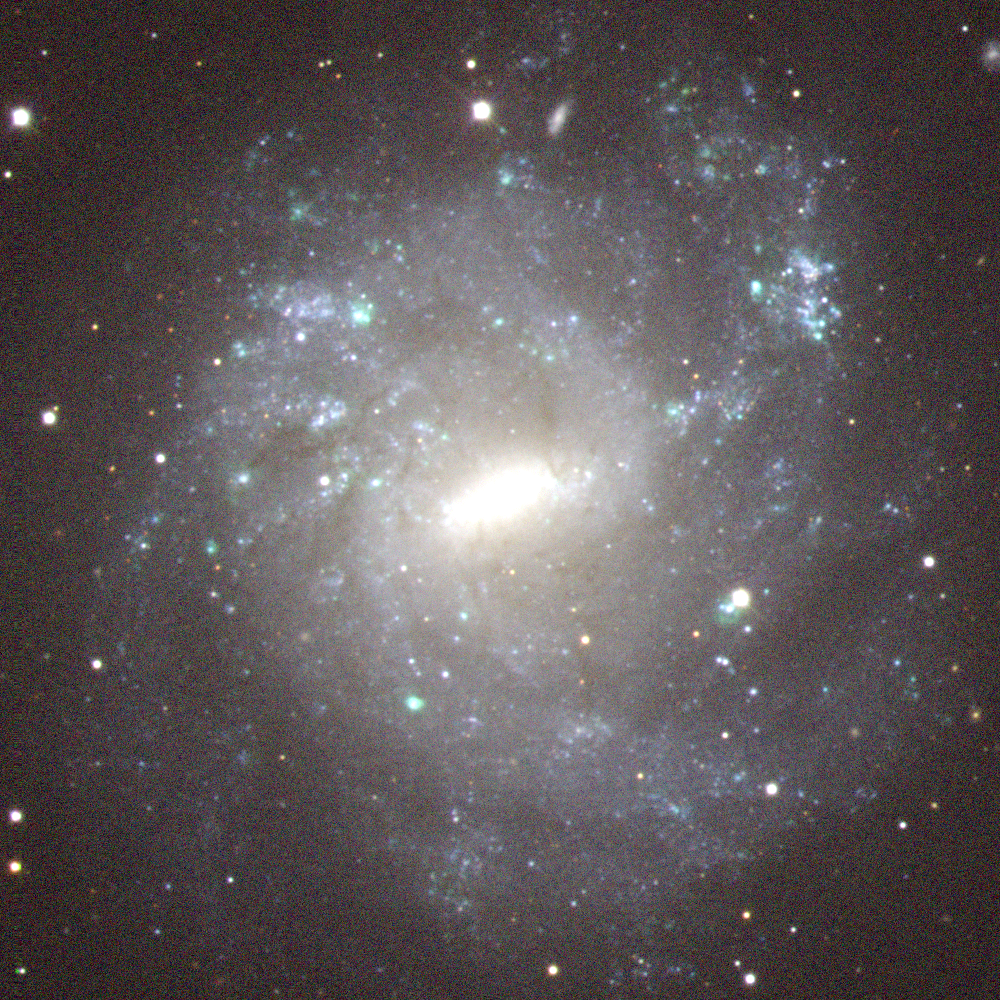
Sonifications from Sound Textures
Inspired by a discussion with professors in the psychology department at NYU, I’ve started exploring sound textures. The formal definition of sound textures (or auditory textures) is sound arising from the overlapping of similar acoustic events in time, but here I am stretching the definition a bit to be just non-musical, ambient kinds of sounds -- think birds chirping, waterfalls, or a jackhammer. My experiments here are strongly inspired by work out of the McDermott lab - in their work, they produce new auditory textures from basic statistics, using clever filters modeled on how our ears work. In the example I give below, I simplify their approach dramatically. A future improvement would be to adopt similar filters
How it works
As discussed in The Basics, I start off by doing a basis function expansion of imaging data. From this, I get a set of weights. A sound texture can be represented by a distribution of frequencies that make up that sound -- what if I reweight these frequencies by the information that I get out of my expansion?
I start off by selecting a texture from the BBC sound effects archive and doing a Fourier transform of the sound to retrieve the frequency and amplitude information. I then do some questionable smoothing and identify the peaks in the frequency distribution, then use those frequencies in my sonification. Each term from the expansion is then assigned one of these frequencies, such that frequencies that are higher amplitude in the sound texture generally correspond to larger weights in the expansion, and the amplitude of the frequency is the weight from the expansion. To make it a bit more pleasant to listen to, I do some harmonics of the frequency and multiply by a decaying exponential. See below for a few examples of different textures of the same galaxy!