About
Around Sound documents a variety of different data sonification projects within our research group. Each project uses basis function expansions to map imaging data to sounds, but makes different choices in the data, mapping, etc. See below to learn more about sonification and basis functions, and check out the rest of our blog to learn about some of our work to date.
Sonification
Sonification is the mapping of data to sounds, and is the aural equivalent to visualizations. While this may feel odd to some folks, there are already a variety of data streams that are predominantly presented aurally -- a geiger counter, for example, or a pulse oximeter machine.
Basis Function Expansions
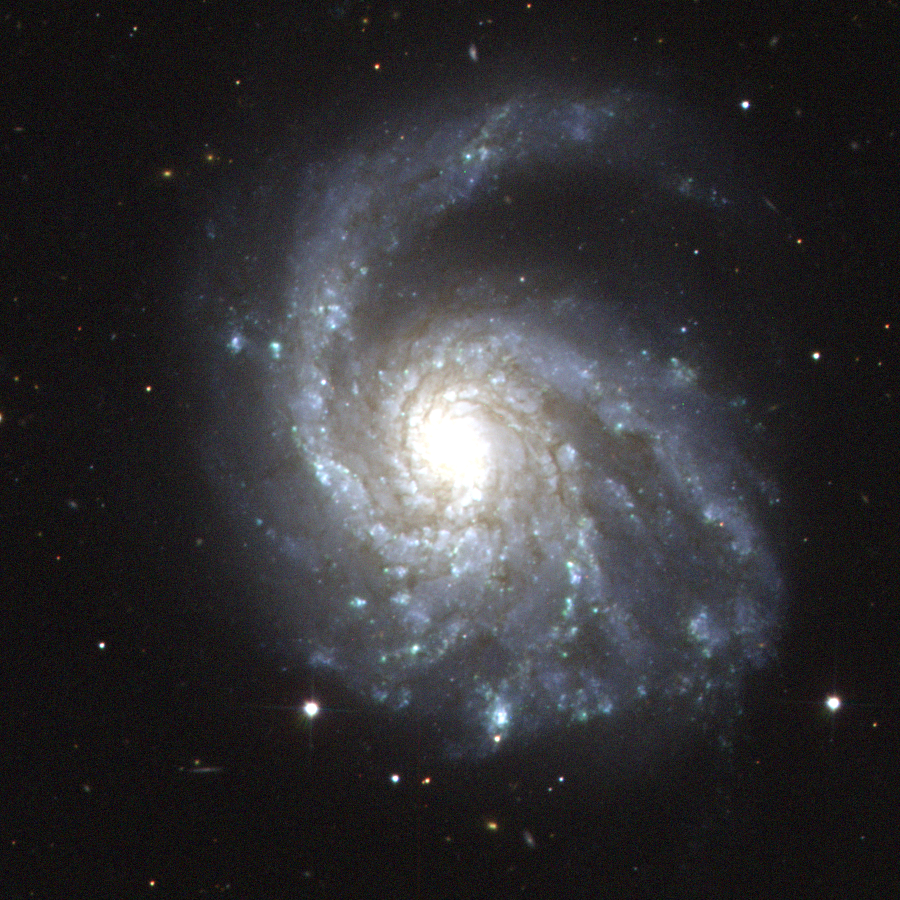
Basis function expansions (BFEs) can be used to describe and summarize key features of galaxies. A BFE uses the sum of weighted, relatively simple equations to represent a more complex distribution. When working with images, we use BFEs to represent the light profile of galaxies. In this expansion, each term represents a different physical scale (size), and the weight on each term indicates how much that term contributes to the overall brightness of the galaxy. BFEs can be thought of as a unifying language or framework for thinking about galaxies. This language quantifies the structure in galaxies and can provide a mathematical description of what galaxies look like and how they evolve. This unifying language also lends itself to representing the galaxies through a sound. By sonifying the weights on each term in the expansion, we can communicate all of the relevant structural information about a galaxy through a single chord.
To learn more about the technical details and see 2D BFEs in action, check out Ganapathy et al., 2025 and Martinez et al., 2026. To learn more about 3D BFEs, check out the EXP webpage
About Us
I’m Carrie Filion, a postdoctoral research fellow at the Center for Computational Astrophysics at the Flatiron Institute, and I run both this blog and the Around Sound research group. My PhD is in astrophysics, and in using BFEs in my day-to-day research work to learn about galaxy formation and evolution, I realized that we could also use BFEs to sonify data. I teamed up with Mike Petersen to develop this idea further, and Mike has been instrumental in working out many of the technical aspects of 2D BFEs as well as our first mapping tests. Along with some phenomenal students, we’ve been working on various applications of 2D BFEs, including sonifications -- some of the astronomy applications can be found in our group GitHub repository.
This work is only possible thanks to a team of researchers, thanks especially to Ananya, Megan -- Ganapathy et al., 2025 and Martinez et al., 2026 -- Claire, and Rashid! We are developing new collaborations with folks in a variety of interdisciplinary spaces, including psychology, music technology, and beyond. Stay tuned!