The Basics
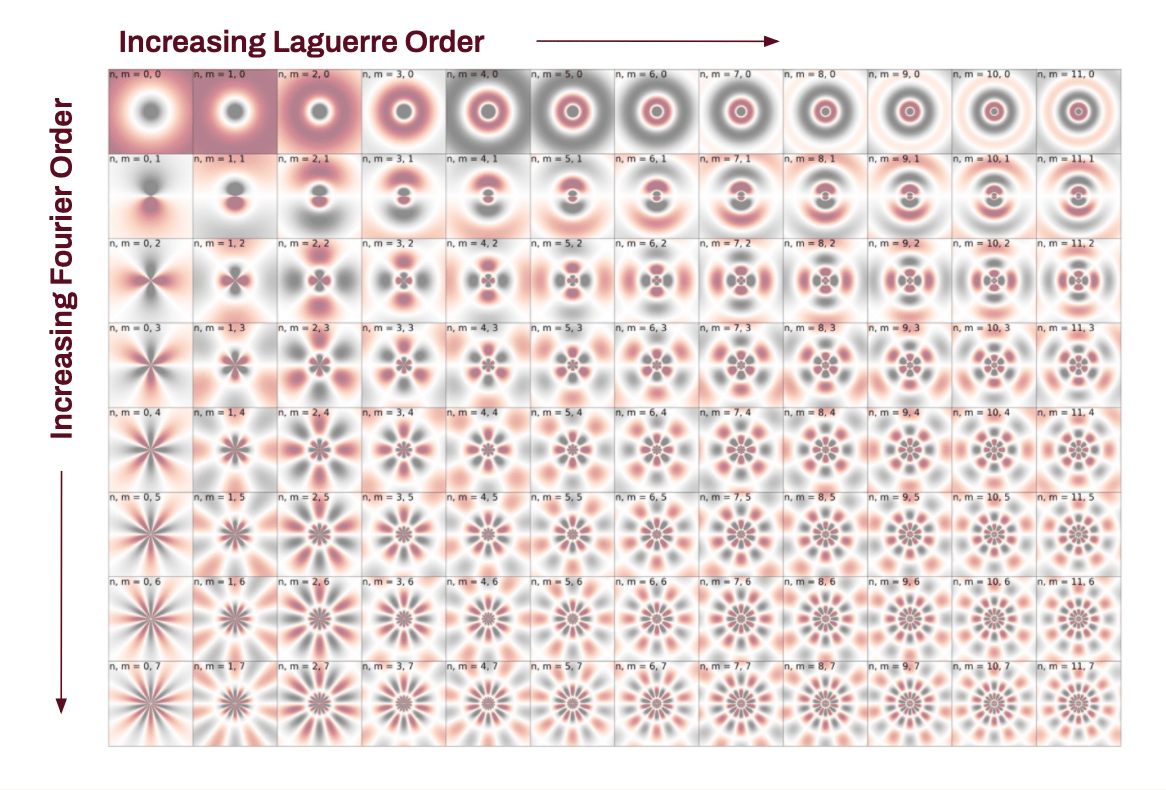
Instead of sines and cosines, we represent the light profiles of galaxies as a Fourier-Laguerre basis. Face-on disk galaxies are generally well approximated by an exponential profile, and this basis has the handy property that the zeroth term is just an exponential profile, meaning that higher order terms represent structure and/or inclination. A visual representation of the basis is seen below, where the Fourier terms (m’s) provide angular information and the Laguerre terms (n’s) provide radial information. By adding combinations of m’s and n’s with different weights, it is possible to represent a variety of galaxy morphologies.
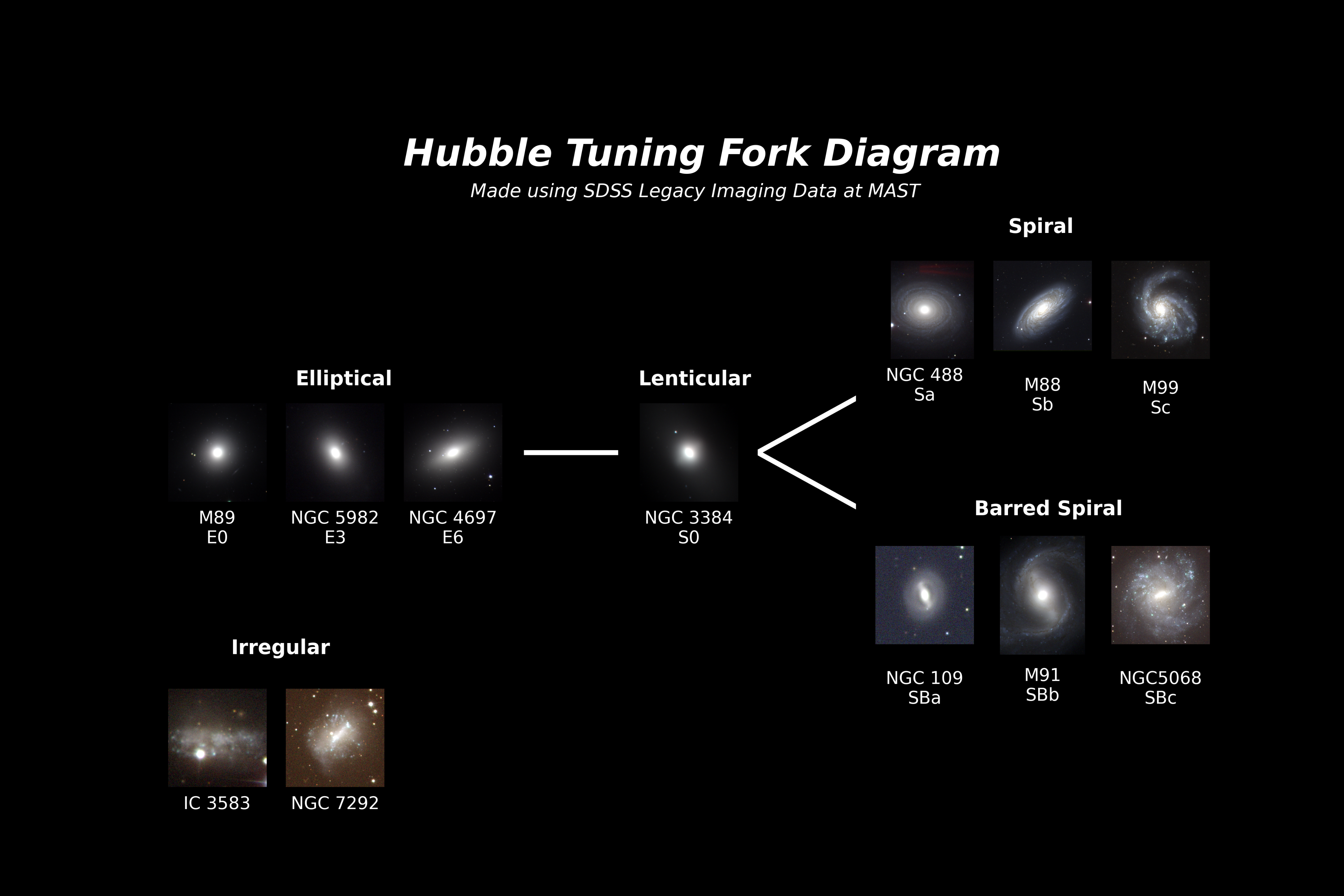
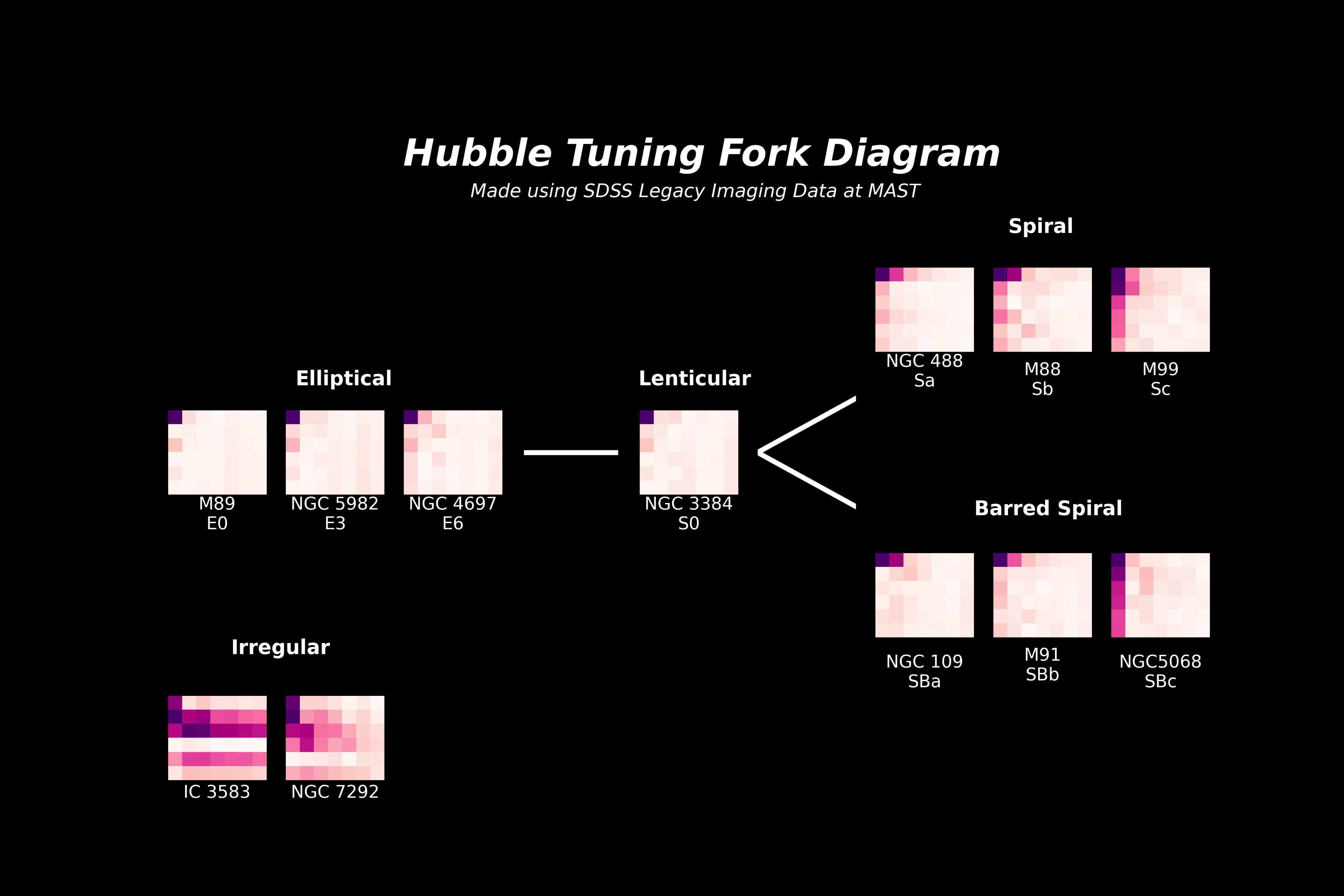
To turn galaxies into sounds, we perform a BFE on the pixel data and retrieve weight information. We then pick a mapping to turn these weights into sounds! A mapping that we often use is to map the Fourier m’s to octaves, and the Laguerre n’s to notes, such that increasing frequency corresponds to finer, smaller-scale structural features in a galaxy. In this way, we can go from a Hubble tuning fork of visual classification morphologies, to coefficient weights, to sounds.
The visual Hubble tuning fork
The coefficient Hubble tuning fork
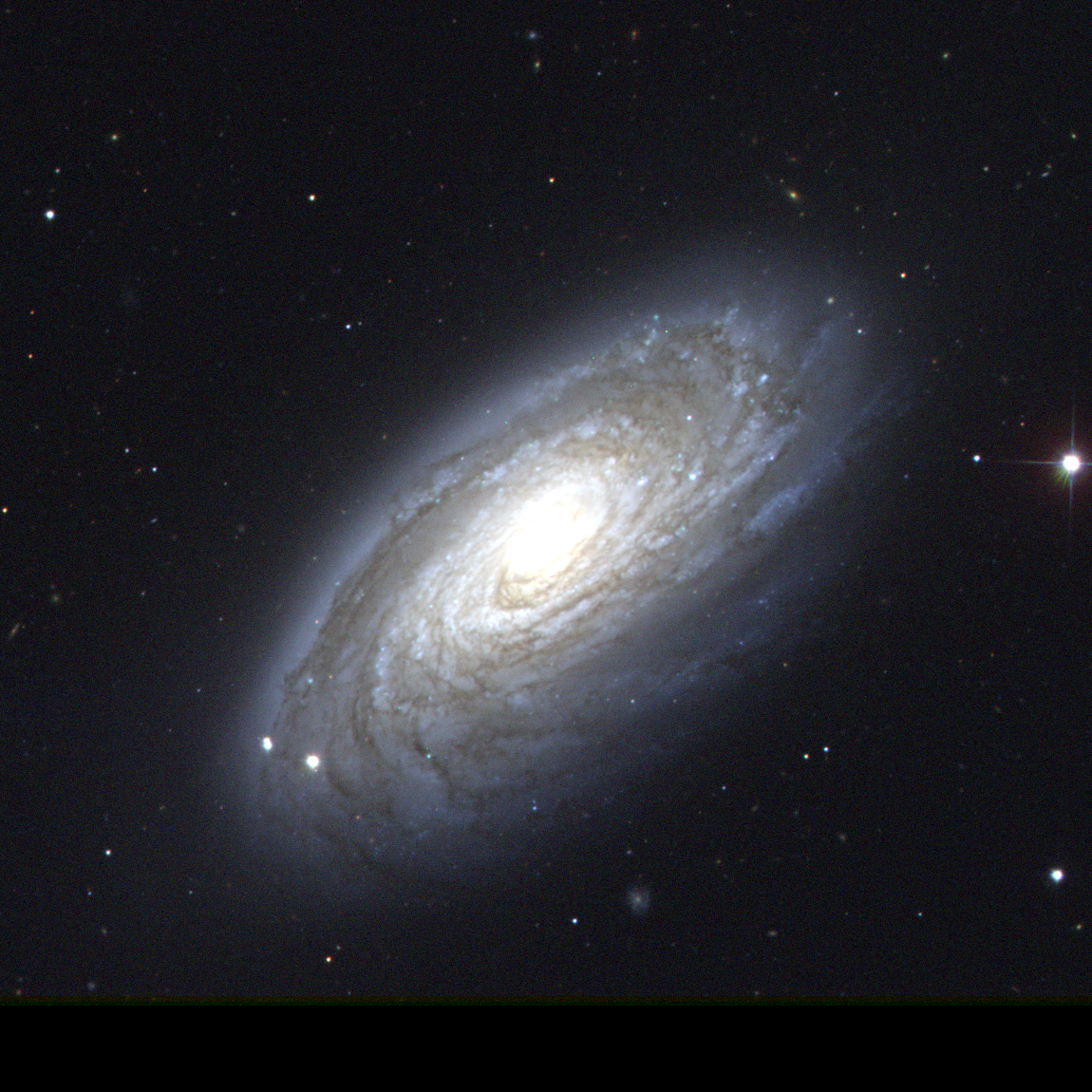
By turning images of galaxies into sounds, we can hear the structures in the galaxies. Can we use these sounds to classify galaxies? Help us build the first-ever audio-based galaxy classification project by taking this survey!
Fun fact: this will be the first-ever non-visual galaxy classification program!
The Basics
Instead of sines and cosines, we represent the light profiles of galaxies as a Fourier-Laguerre basis. Face-on disk galaxies are generally well approximated by an exponential profile, and this basis has the handy property that the zeroth term is just an exponential profile, meaning that higher order terms represent structure and/or inclination. A visual representation of the basis is seen below, where the Fourier terms (m’s) provide angular information and the Laguerre terms (n’s) provide radial information. By adding combinations of m’s and n’s with different weights, it is possible to represent a variety of galaxy morphologies.
To turn galaxies into sounds, we perform a BFE on the pixel data and retrieve weight information. We then pick a mapping to turn these weights into sounds! A mapping that we often use is to map the Fourier m’s to octaves, and the Laguerre n’s to notes, such that increasing frequency corresponds to finer, smaller-scale structural features in a galaxy. In this way, we can go from a Hubble tuning fork of visual classification morphologies, to coefficient weights, to sounds.
The visual Hubble tuning fork
The coefficient Hubble tuning fork
Aural classifications?
By turning images of galaxies into sounds, we can hear the structures in the galaxies. Can we use these sounds to classify galaxies? Help us build the first-ever audio-based galaxy classification project by taking this survey!
Fun fact: this will be the first-ever non-visual galaxy classification program!
The Basics
Instead of sines and cosines, we represent the light profiles of galaxies as a Fourier-Laguerre basis. Face-on disk galaxies are generally well approximated by an exponential profile, and this basis has the handy property that the zeroth term is just an exponential profile, meaning that higher order terms represent structure and/or inclination. A visual representation of the basis is seen below, where the Fourier terms (m’s) provide angular information and the Laguerre terms (n’s) provide radial information. By adding combinations of m’s and n’s with different weights, it is possible to represent a variety of galaxy morphologies.
To turn galaxies into sounds, we perform a BFE on the pixel data and retrieve weight information. We then pick a mapping to turn these weights into sounds! A mapping that we often use is to map the Fourier m’s to octaves, and the Laguerre n’s to notes, such that increasing frequency corresponds to finer, smaller-scale structural features in a galaxy. In this way, we can go from a Hubble tuning fork of visual classification morphologies, to coefficient weights, to sounds.
The visual Hubble tuning fork
The coefficient Hubble tuning fork
Aural classifications?
By turning images of galaxies into sounds, we can hear the structures in the galaxies. Can we use these sounds to classify galaxies? Help us build the first-ever audio-based galaxy classification project by taking this survey!
Fun fact: this will be the first-ever non-visual galaxy classification program!